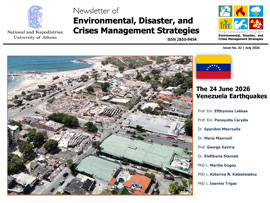

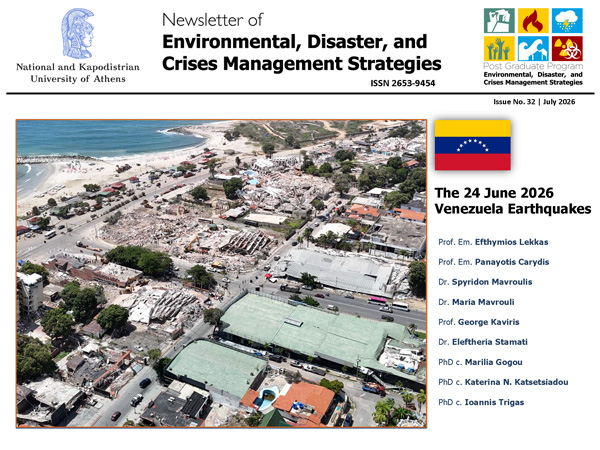
The 32nd issue of the “Newsletter of Environmental, Disaster, and Crises Management Strategies (EDCMS)” is dedicated to the earthquakes that struck the northern part of Venezuela (South America) on June 24, 2026 with magnitude Mw=7.2 and Mw=7.5.
The issue is a synthesis of: (a) the field observations collected during the Greek scientific mission to Venezuela; (b) published information obtained from international scientific organizations, governmental agencies, the scientific literature, and of reliable sources; and (c) experience gained from past earthquake disasters.
The field scientific investigation was conducted by Professors Emeritus Efthimios Lekkas and Panagiotis Karydis. The mission was carried out within the framework of international scientific, technical, operational and humanitarian assistance to the areas affected by the strong earthquakes of June 24, 2026. Its main objectives were to investigate the geodynamic and seismotectonic regime of the affected area, to record and evaluate the impacts of the earthquakes on the built environment, to assess geological hazards and to provide scientific support to local authorities and the international disaster response community.
The compilation, critical review, and synthesis of the field observations, published information, and experience from previous earthquake disasters were undertaken by Professor Emeritus P. Karydis and the members of the Interdisciplinary Committee for Risk and Crisis Management of the National and Kapodistrian University of Athens, Professor Emeritus E. Lekkas, Professor Georgios Kavyris and Dr. Spyridon Mavroulis, with the contribution of specialized collaborators Dr. Maria Mavrouli, Dr. Eleftheria Stamati and the doctoral candidates Marilia Gogou, Katerina – Navsika Katsetsiadou and Ioannis Trigas.
The 32nd Issue of the “Newsletter of EDCMS” includes the following main thematic sections:
- Geological, geodynamic and seismotectonic context of northern Venezuela, with reference to the geological structure of the region, active faults, seismicity, and the evolution of earthquake design regulations.
- Historical and recent seismic activity, with an analysis of the major earthquakes that have affected northern Venezuela and their impacts.
- Analysis of the seismic sequence of June 24, 2026, including the main seismic parameters, the spatial distribution of the effects and the characteristics of the ground deformation.
- Primary and secondary environmental impacts of earthquakes, with emphasis on geological hazards, such as landslides, liquefaction, soil deformations and landforms from mud volcano activation.
- Impacts on the built environment, with an assessment of damage to buildings and infrastructure, the seismic vulnerability of structures, failure mechanisms and parameters affecting their seismic behavior.
- Impacts on the population, critical infrastructure and public health, including humanitarian consequences, health challenges and psychosocial impacts following a major seismic disaster.
- Emergency response and disaster management, with reference to search and rescue operations, early warning systems, immediate response actions and lessons learned for improving preparedness and resilience.
- Information management during disasters, examining the challenges arising from misinformation and the dissemination of inaccurate information during the critical post-earthquake period.
Beyond documenting the 24 June 2026 earthquake sequence, this Newsletter aims to provide an integrated multidisciplinary reference on one of the most significant recent earthquake disasters in northern South America. It combines field observations, scientific analyses and operational experience to support future research, improve earthquake risk assessment, strengthen disaster preparedness and response, and contribute to the mitigation of the impacts of future destructive earthquakes in Venezuela and other tectonically active regions.
The issue is available here.